
Education
Explore the principles behind Bitcoin
Bitcoin is an attempt to innovate money. And like all innovations, it challenges the status quo. Therefore, to truly understand Bitcoin, you must be willing to think outside the box and question the long-held assumptions and beliefs you’ve been conditioned to accept. Bitcoin challenges the very system we’re used to.
We’re taught that:
- Prices naturally rise over time and that inflation is necessary
- Buying a home requires going into debt
- The money in our bank account is truly ours
- A central bank is essential
We tend to accept these statements as givens—almost like natural laws. But reality tells a different story. Some of the most advanced periods in history have seen falling prices, and saving—not debt—was once the norm for buying a home. Too often, bank runs occur, governments freeze accounts, entire currencies collapse through hyperinflation, and central banks create money to fund wars that the average person neither wants nor chooses, but ultimately pays for through a debased currency.
Bitcoin is proposed as a solution to these kinds of problems: a system where individuals regain financial sovereignty and freedom. It is money built by the people, for the people—a monetary system designed to reward delayed gratification rather than those closest to the money printer.
Read more
Sound Money
I say “proposed solution” because Bitcoin is not alone. Throughout history, people have searched for what is called “Sound Money”, which is money that is not corrupted by anyone and holds its value. The word historically refers to money that is reliable and trustworthy, but it also relates to the fact that empires and kingdoms used to devalue their gold currencies by reducing the gold content of coins to fund their own activities, and people could often tell which currency was not debased because pure coins would ring and make a clear “sound” when dropped. Gold fulfilled this role in the physical world for centuries—from the first gold coins in Lydia around 600 BC—until 1971, when the U.S. dollar, the world’s reserve currency, was taken off the gold standard entirely. Today, various alternatives exist, including other cryptocurrencies attempting to solve similar problems. All of these ideas point toward one concept: Sound Money.
The Big Picture
The bigger picture is not about which form of money “wins,” but about achieving money that cannot be corrupted or manipulated by any authority. At the same time, Bitcoin is not about anarchy or removing all forms of authority. It is about decentralizing control, not eliminating structure. This is a pattern we’ve seen throughout history.
- The printing press decentralized information that was once monopolized by the state, the church, and the nobility.
- The Internet decentralized communication, allowing anyone to share information globally.
- Modern democratic governments use systems like the separation of powers to distribute authority and prevent any single entity from having total control.
Bitcoin follows this same principle — decentralizing money so that no single party can control or corrupt it. This idea is at the very core of why Bitcoin was created. As Satoshi Nakamoto wrote:
“The root problem with conventional currency is all the trust that’s required to make it work. Banks must be trusted to hold our money and transfer it electronically, but they lend it out in waves of credit bubbles with barely a fraction in reserve. The central bank must be trusted not to debase the currency, but the history of fiat currencies is full of breaches of that trust.”
Bitcoin vs Crypto
Lastly, it is important to distinguish between Bitcoin and the broader crypto space. There are millions of Cryptocurrencies out there, but extremely few actually serve a useful purpose. You can paint a rock gold, but that doesn’t make it gold. The same applies to most cryptocurrencies. There are many projects—though not all—that imitate the idea of sound money without truly achieving it. Separating signal from noise is therefore essential. Most crypto’s don’t aim to be money either. Many projects explore different ideas, such as Web3 — decentralization of platforms, applications, ownership, and identity — as well as smart contract platforms, and decentralized governance systems for online organizations. There are also a large number of crypto projects designed primarily to benefit their creators rather than solve meaningful problems.
This website focuses on one thing only: Crypto As Money.

Courses
Learn Bitcoin fundamentals through structured courses—build a solid understanding from basics to advanced concepts.
(Coming Soon)

Articles
Thoughts on Bitcoin and Sound Money, written over time
(No Article Available yet)
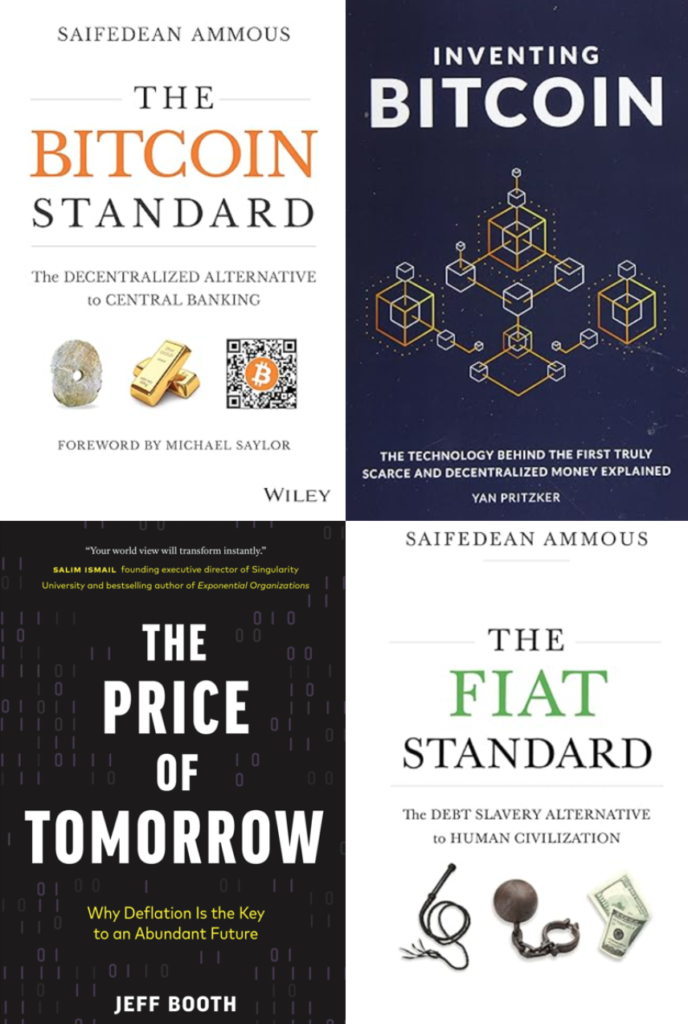
Recommended Books
- The Bitcoin Standard: The Decentralized Alternative to Central Banking
- Inventing Bitcoin: The Technology Behind the First Truly Scarce and Decentralized Money Explained
- The Fiat Standard: Debt Slavery Alternative to Human Civilization
- The Price of Tomorrow: Why Deflation is the Key to an Abundant Future